Unused and degraded industrial sites represent both a challenge and a significant development opportunity for local communities. Instead of creating new industrial zones on greenfield land, revitalising existing brownfield sites allows for more efficient use of available space, existing infrastructure and economic potential, while reducing pressure on new land.
ReInd-BBG — Brownfield is Better than Greenfield
A project co-funded under the Interreg Danube Region Programme, bringing together 16 project partners from seven Danube Region countries — Slovenia, Bosnia and Herzegovina, Serbia, Bulgaria, Romania, Montenegro and Austria — led by the Chamber of Commerce and Industry of Slovenia.
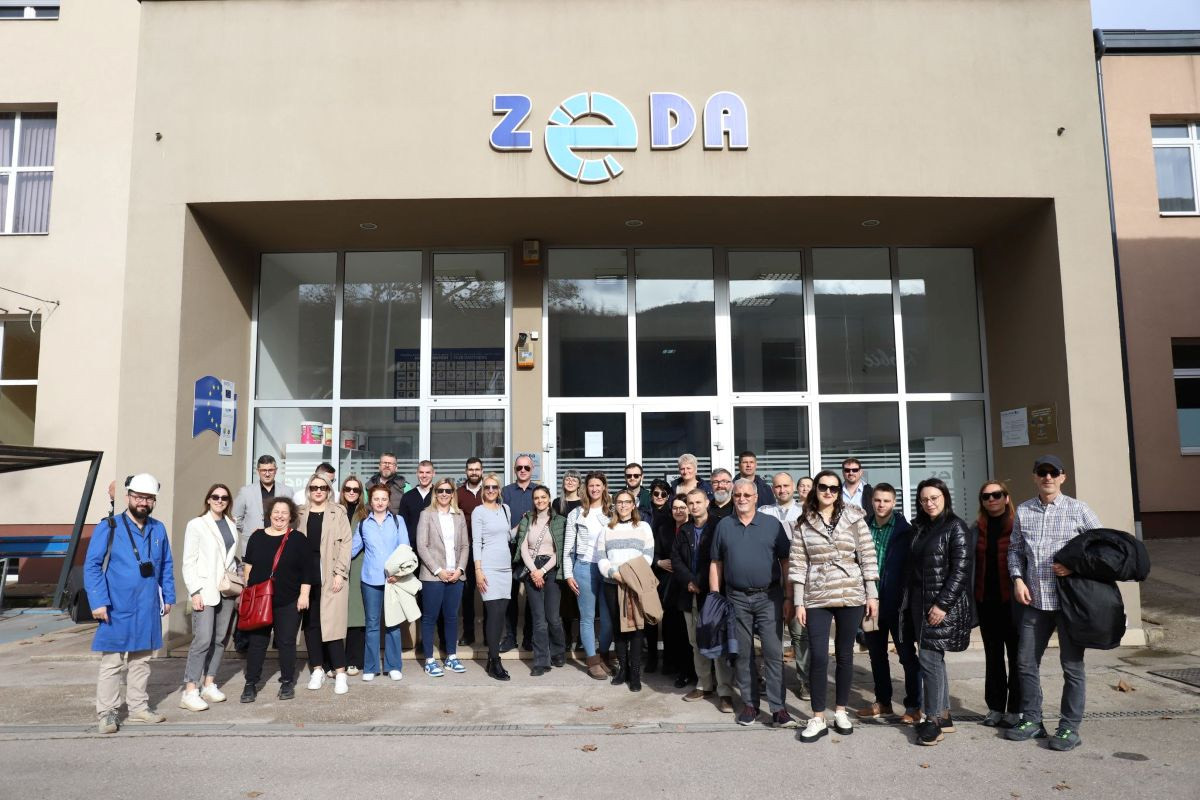
- Partners from Bosnia and Herzegovina: the City of Zenica, Eko-forum Zenica, and the Professional Service for Development and International Projects of Zenica-Doboj Canton
- Contribution of the BiH partners: transferring project experience and results into the local and regional context
This is the principle behind the ReInd-BBG project. During implementation, a range of practical tools, methodologies and lessons were developed that are not intended solely for the pilot sites included in the project — their real value lies in how adaptable they are for use in other local settings.
Practical tools developed through the project
One of the key results is the Brownfield Assessment Tool, a tool for the structured assessment of brownfield sites. It enables a better understanding of a site's current condition, potential risks and constraints, and its development possibilities, providing a stronger basis for decision-making. The tool can be useful to local authorities, planners, development agencies, site owners and other organisations involved in brownfield regeneration processes.
Zenica Business Zone 1 — a local example
An important local example is Zenica Business Zone 1, where a pilot site analysis was carried out as part of the project. This experience shows how the brownfield assessment approach can be applied in a concrete local context and serve as a basis for considering possible future development scenarios.
From assessment to planning: scenario building and Local Action Planning
Alongside site assessment, ReInd-BBG developed an approach to scenario building and Local Action Planning, enabling the shift from identifying potential to more concretely considering possible development directions, priorities and next steps. This approach can be especially valuable for local communities that want to plan the revitalisation of their brownfield areas more systematically.
Availability isn't enough: investment readiness
The mere availability of a brownfield site is not enough to attract investors.
One of the project's important conclusions is that work is needed on a site's investment readiness, including questions of:
- accessibility and infrastructure
- planning documentation
- the business environment
- availability of labour
- stakeholder relations
- clearly defined investment opportunities
The community as a partner: the Community Engagement Kit
Brownfield revitalisation is not only a technical or spatial-planning process. Successful reindustrialisation requires the involvement of local authorities, the business sector, investors, site owners, development agencies, citizens, non-governmental organisations and the academic community. That is why ReInd-BBG also developed a Community Engagement Kit, which includes various methods of stakeholder engagement, such as stakeholder mapping, interviews, focus groups, round tables, participatory workshops and feedback channels.
The Transnational Roadmap
A wider strategic framework is provided by the Transnational Roadmap, which aims to translate the experience and lessons learned from the pilot areas into a broader approach to brownfield reindustrialisation, and to open the way for their inclusion in local, regional and national policies.
What can be transferred?
The value of the ReInd-BBG results lies precisely in their practical applicability. The brownfield assessment method, the experience from the pilot analyses, the scenario-development approach, Local Action Planning, the investment-readiness concept, the stakeholder engagement methods and the Transnational Roadmap are all resources that can be adapted to different local needs.
For Zenica and the wider region, this provides a basis for further thinking about which sites have potential for revitalisation, what the key challenges and obstacles are, which development models are possible, and which institutions and stakeholders need to be involved in the process.
Transferring the ReInd-BBG results therefore does not mean simply adopting ready-made solutions. On the contrary, the goal is to adapt the existing tools and experience to the local context and use them to support future processes of planning, revitalisation and reindustrialisation.
In this way, ReInd-BBG turns project outputs into practical resources for future local action — with the potential to support more sustainable use of space, new economic opportunities and better-informed decision-making on brownfield sites.
For organisations and institutions considering similar challenges — whether assessing a site's potential, planning development, or preparing an EU call application — ConVita is available through its project development and EU funds and public-private partnership services.
ReInd-BBG is co-funded under the Interreg Danube Region Programme of the European Union. This article shares publicly available project results and lessons for informational purposes; ConVita is not a ReInd-BBG project partner.